In Wisconsin, poorly performing virtual charters won’t affect their districts

Provision would exclude virtual schools’ scores in certain cases

virtual-schoolA little-known provision slipped into the Wisconsin budget signed by Gov. Scott Walker would keep low-performing virtual charter schools from dragging down the report cards of districts that host them.
The new law excludes the achievement scores of virtual charter schools from districts’ annual state report cards if more than half the students enrolled in the virtual school reside outside the district.
The provision was sought by the leaders of the only two virtual schools in the state to receive failing grades on their most recent school report cards: eAchieve Academy, hosted by the Waukesha School District, and iForward Academy, hosted by the Grantsburg School District. Both districts still met or exceeded the state’s expectations on their annual report cards.

But State Superintendent Tony Evers is critical of the change, saying it’s inconsistent with the idea of bringing all publicly funded schools into the same school accountability system. He sought unsuccessfully for Walker to veto the item.
Proponents say virtual charters should be treated differently because they’re serving many children not living in the district, who often have not been successful in other school settings and are coming to a virtual charter as a last resort — often bringing low achievement scores with them.
Rick Nettesheim, principal of Waukesha’s eAchieve Academy, said district report cards are meant to track the progress of students from elementary school through high school, and virtual school students often come from outside their resident district, which wouldn’t accurately reflect the achievement of the district.
“The truth is that virtual schools draw in by their very nature a fairly diverse population of students,” Nettesheim said. “Some of that diversity is a large group who are not successful in their resident school, and they look to virtual school as a last hope.”
Because they are online programs that allow teachers and students to work from home, virtual schools can enroll children all over the state through the state’s open enrollment program.
The Department of Public Instruction lists 32 virtual charter schools for the 2014-’15 school year, with three more proposed for the upcoming school year.
In 2013-’14, the most recent year report cards were issued, 27 of the 31 virtual schools that received state report cards “met expectations.” Two “exceeded expectations,” and two “failed to meet expectations.”
No schools or districts will receive report cards for the 2014-’15 school year. Separate legislation signed by Walker in May paused the system for a year while a new state test was implemented.
Report cards assess performance
In recent years, Wisconsin created a new system to judge public school and district performance. Annual report cards distributed to the public now rank schools and districts in one of five categories, from “significantly exceeds expectations” to “fails to meet expectations.”
The new state budget calls for those descriptions to be replaced with a five-star rating system.
The report card scores are based on measures such as achievement on the state test and academic growth over time, as well as school attendance and achievement gaps. Schools started receiving report cards in 2011-’12; districts started receiving them a year later.
The whole system went into place as part of a federally approved waiver from increasingly strict mandates of the No Child Left Behind law. Congress is in the process of rewriting that law.
Nettesheim said the report cards treat students as if they have been enrolled in the school year after year, which is often not the case for virtual schools, where kids from around the state may enroll and drop out more frequently.
He added that virtual schools are still being held accountable because each virtual charter school still will receive an individual school report card. Their scores would simply be excluded from the districtwide report card.
But many brick-and-mortar schools also see high student turnover, and their school scores still contribute to the districtwide report card.
For example, many Milwaukee city schools that serve vulnerable populations see up to a third of students turn over during the school year. Yet their scores still contribute to the Milwaukee Public Schools districtwide report card.
Request drove change
State Sen. Luther Olsen (R-Ripon) added the provision to the budget at the behest of Nettesheim and Joni Burgin, superintendent of the Grantsburg school district. Olsen said the provision will help encourage school districts to continue supporting virtual programs.
“The district is doing mission work (taking on virtual schools),” Olsen said. “I don’t think the system is reflected badly on the district; we don’t want these districts to not do this anymore because it’s bringing down the grade for the district.”
Olsen said the provision encourages more districts to host virtual schools because of the reduced risk.
Evers, the state superintendent, disagrees.
In a veto letter to Walker, Evers said the accountability data for all students attending a virtual school — not just the students who attended via open enrollment — would not be reflected on any district report card.
Still, Blake Peuse, superintendent of the Northern Ozaukee School District, said virtual school performance doesn’t accurately reflect the performance of the district.
“Virtual schools, for the most part, are a completely different entity,” Peuse said. “Having it directly equated to the sponsoring district does not always tell the whole story.”
Northern Ozaukee’s virtual school, Wisconsin Virtual Learning, received a “meets expectations” on the latest round of school report cards.
The district received the same marks.

Can online tutors make anytime, anywhere learning a reality?

Supporting off hours learning is a problem you might not even know you have

tutors-online
Recently, I began dubbing the current generation of students the “Netflix Generation.” They learn when they want, and expect learning resources to be available when and where they need them.
This is similar to the way they consume media through streaming services such as Netflix (for movies and television series) and Spotify (for music); they binge watch TV series multiple episodes in a row, and they expect a wide range of music to be available when and where they want. If they listen to a song in the car, they expect to be able to pick it back up in the house or while waking down the street. Increasingly, they expect learning resources to be available in the same fashion.
Smart educational organizations have built rich online courses filled with learning resources to support this type of learning. The old paradigm where learning occurs only in a classroom or lecture hall during school hours is gone. But in off hours, when teachers are at home, what will take their place?
After a few years of building online courses with rich learning resources, my school now sees significant student use outside the traditional school hours.
ole-graph
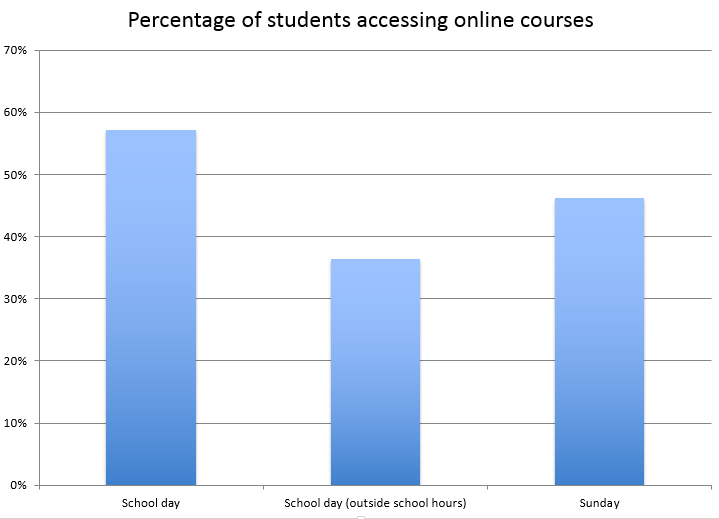
Graph 1 (click for full size) – This graph shows the percentage of the Year 7 to 12 population that accessed the online learning environment. The graph showing the school day is an average figure derived from two weeks of data. The Sunday and outside school hours data is derived from recent individual days.
Anytime, anywhere teaching
However, this now produces other pressures. Learning outside of traditional school hours does not remove the need for teachers. If all that students needed in order to learn was information, schools would have closed once Google and high-speed broadband arrived on the scene. Students continue to need support, a human explanation, encouragement to work through a problem, and insight to take them through a mental barrier to get to the next stage of problem solving.
Yet if significant learning is happening outside traditional school hours, who is available to support it? Do we expect our teachers to be online and available at all hours of the day or night? Or do we expect our students to continue independently, even when they encounter difficulties? The ad hoc network of peers that some students have may not be able to provide the rapid, deep, expert insights that are needed.
ole-graph-2
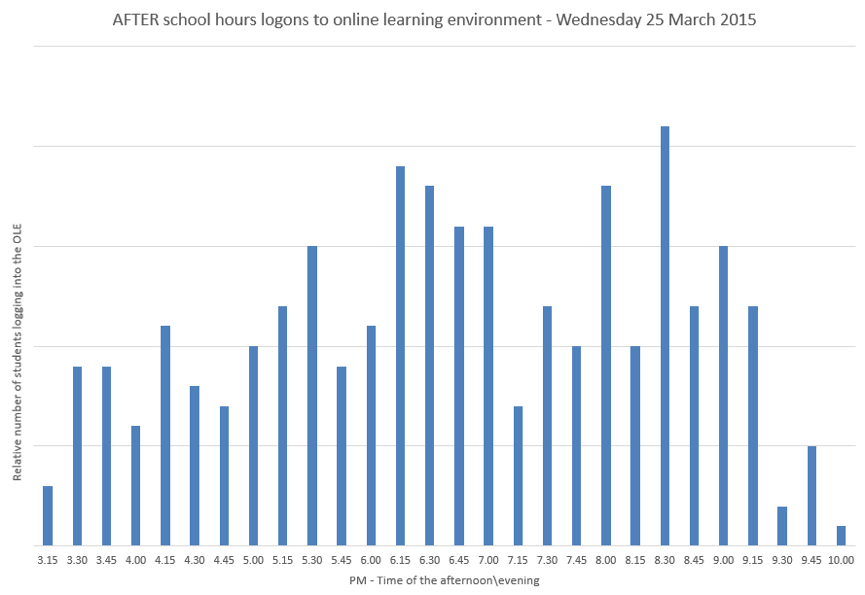
Graph 2 (click for full size) – Student logons to the OLE after school. (Classes finish at 3.15pm). This is a snapshot of the number of students logging in to the system at a particular time. It is not the total number of students using the OLE at that time.

My organization has provided a solution to this problem. We have provided access to online tutors — accessible via a link in every course in our OLE (online learning environment).
This is an external service where students can get the support that they need; our teachers do not need to be available all night. There is no need to navigate to a separate web site, or to remember yet another user name and password. The external service has the student’s name, year level and the course they navigated from passed to them as part of the single sign on process (via LTI integration). It couldn’t be easier. (My school, which is in Australia, uses yourtutor, a local company that works with both secondary and higher education institutions. There are similar services for schools stateside, such as Tutor.com, although I personally cannot vouch for them).
yourtutor-page
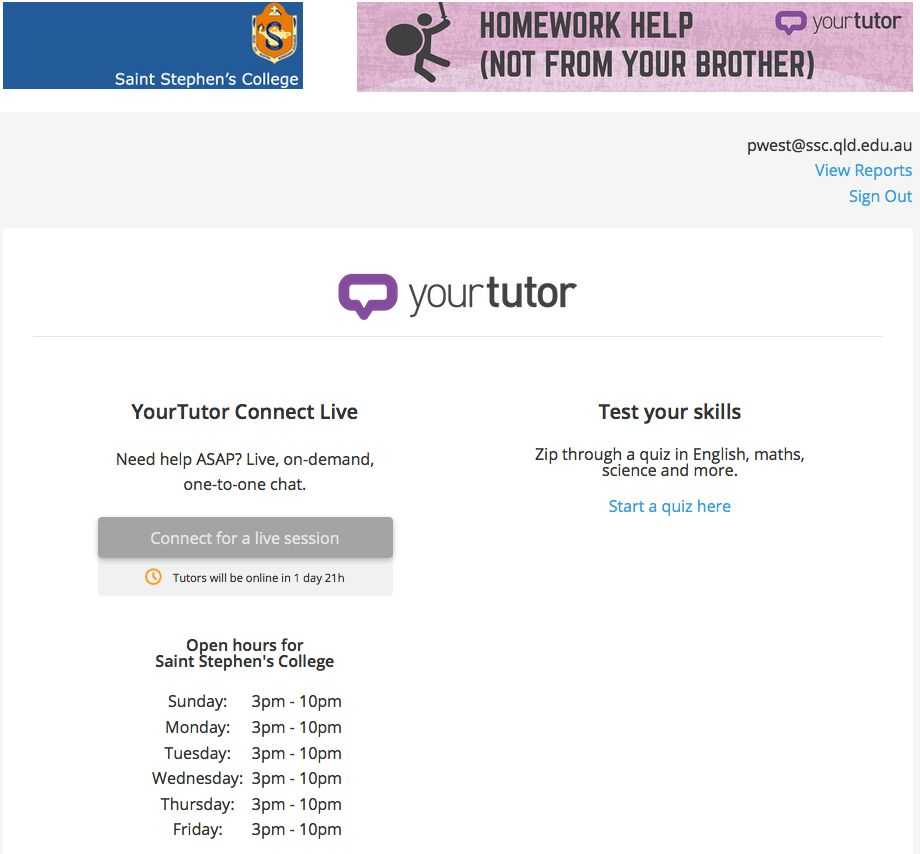
The front page of the external support service showing the hours when it is available. This screen shot was taken on a Saturday afternoon; the service is open during the hours when many students study, rather than being available 24/7.
Usage of the system is consistent, has been growing in the past year, and has received good feedback from students.
Some comments from students include:
  • “[xxxxx] was a great tutor and was very helpful. Described what he meant and made sure I understood.”
  • “My tutor was very helpful and wasn’t hesitant to give examples.”
  • “Patient with me and helped me find some information on what I was stuck with.”
The online tutors do not simply answer a question; they instead act as teachers to guide students to an answer. Students can now gain the help they need, when they need it, teachers can have the out-of-hours break that they need, and the school can be confident that they are supporting both their students and their staff.
Peter West is Director of eLearning at Saint Stephen’s College in Australia. He has over 15 years’ experience leading K12 schools in technology enhanced education, particularly blended learning using online learning environments. He can be contacted at

Rural district turns to online speech therapy

Economically disadvantaged district, facing recruiting difficulties, found online therapy resources

online-therapyAlthough districts are required to provide students in need with special education and related services such as speech therapy, many face obstacles in doing so.
One such school district, Lone Pine Unified (LPUSD), an economically disadvantaged district near the California-Nevada border, found it hard to recruit and retain speech-language pathologists (SLPs) because of its location.
To overcome this challenge, LPUSD chose to use online speech therapy through PresenceLearning and is seeing great success.

“Research shows that socioeconomic status is the number one statistic in predicting overall student and school district underachievement, and approximately 70 percent of our students are socioeconomically disadvantaged,” said Dr. Sean A. Cianfarano, Superintendent of LPUSD. “However, with PresenceLearning and our pre-academic early intervention efforts spearheaded by our excellent educators and support staff, we are now beating the odds at LPUSD.”
After the 2013-2014 school year, LPUSD was one of 10 districts to receive PresenceLearning’s Award of Excellence. Of the nearly 1,000 schools PresenceLearning served that school year, the award was given to those districts with the highest percentage of students who improved one level or more in spoken language production and spoken language comprehension on the Functional Communication Measures (FCMs) scales during the school year.
Although he was skeptical of its effectiveness when he first moved to the school district in fall 2014, Superintendent Cianfarano was personally won over as he saw how PresenceLearning positively impacted his son Rocco.
While enrolled in Pre-K at his previous district, Rocco’s teacher told his family that he was leaving off the first letter and sound of his words, thus indicating that he may need speech therapy. Once enrolled in kindergarten at LPUSD, Rocco started with PresenceLearning and his family found he flourished both in therapy and in the classroom.
“I would not choose a service option for our school district that we, as a family, would not choose for our own child,” said Dr. Cianfarano. “Early literacy is so important for young learners, but if the student cannot speak, it is really hard for them to be literate because it is all tied together. PresenceLearning empowers students to speak, but it’s more than that. It empowers students to be successful.”
Material from a press release was used in this report.

Some high school students access college courses for free

Students attending an online private school are eligible for college credit

college-creditThe for-profit DeVry University has partnered with Connections Education to offer college courses at no cost to high school students attending International Connections Academy (iNaCA), an accredited, online private school serving students in grades K-12 worldwide.
Through DeVry University’s Passport2College program, juniors and seniors attending iNaCA can earn college credit while still attending high school. Students can enroll in such courses as Computer Applications for Business with Lab, Introduction to Business and Psychology.
“Passport2College is a wonderful opportunity for high school students to learn first-hand the college learning experience,” said Donna Loraine, chief academic officer and provost of DeVry University. “iNaCA students will be able to participate in the same academic learning environment that all DeVry University undergraduates encounter and obtain knowledge of how they can transition from high school to the collegiate level.”
Hannah Rinehart, director of school for iNaCA, commented, “More and more students are interested in taking college courses in high school.” In fact, the numbers topped 1.3 million students in the 2010-11 school year according to the most recent survey on the subject by the National Center for Education Statistics (NCES). “We are excited to bring opportunities like this to our students.”
Passport2College will launch for iNaCA students in the 2015-2016 school year.

How online learning is changing credit recovery

As learning becomes more accessible, credit recovery programs are evolving

credit-recoveryOnline learning is playing an increasingly important part in credit recovery for students with a variety of academic needs, according to a new report from the International Association for K-12 Online Learning (iNACOL).
Credit recovery solutions often lower the bar for student performance as a result of pressure on school administrators and policymakers to “fix” graduation rates, authors Allison Powell, Verena Roberts, and Susan Patrick note.
Many online credit recovery solutions tout low costs but require only low levels of teacher involvement and often don’t use much rigor when asking students to demonstrate proficiency, according to the report.
Here’s where competency-based education comes in. Strong CBE programs will help students focus on their skill gaps, catch up, and stay on track for graduation. This intervention occurs before a student has failed an entire course.
New Hampshire has what the authors call one of the boldest CBE efforts. The Virtual Learning Academy Charter School is a charter school that also serves as the state’s virtual school. Its supplemental online classes include 62 “competency recovery” courses let students take an entire course or allow them to focus just on the competencies they did not pass. Students work with their parents and teacher to determine their individual learning pace.
“Competency-based learning gives students the opportunity to complete lessons that demonstrate their mastery of content as well as the support they need if they are having difficulty with specific content,” the authors wrote. “A true competency-based approach requires the students to advance upon demonstrated mastery—often through a ‘performance’ of demonstrating
the competencies and creating evidence of the deeper knowledge, skills and dispositions acquired.”
“Research shows that more than 75 percent of school districts use blended and online learning for expanded course offerings and credit recovery,” said Allison Powell, iNACOL Vice President for New Learning Models. “The case studies in this paper provide guidance to educators in helping over-age, under-credited students to catch up and get back on track to graduate.”
Susan Patrick, President and CEO of iNACOL, said, “Millions of students are still not completing high school, causing them to face increasing challenges throughout life. When students have struggled, online learning is a tool that can open up new pathways to success—students can find alternative ways to learn and to graduate, while also developing new skills for success in life.”
To read the report in its entirety and for more details about the state of online learning for credit recovery, click here.

Full-time online school launches in Georgia using FuelEd (Aventa)

FuelEd, Vidalia City Board of Education open full-time online school for Georgia students

online-learningThe Vidalia City Board of Education (Ga.) has partnered with personalized learning provider Fuel Education (formerly Aventa Learning) to launch a new full-time online learning program for K-12.
The public, full-time online school, Vidalia Academy, offers students across the state of Georgia the opportunity to learn in a flexible educational model that is tailored to each student’s needs.
Accepting enrollments for the 2015-2016 school year through the end of this month, Vidalia Academy will be able to provide thousands of students with personalized learning through an extensive catalog of standards-based online curriculum, instructional services from highly qualified, state-certified online teachers, powerful course customization and other technology tools, and a host of support resources, all provided by FuelEd.
“Vidalia City Schools selected Fuel Education because of their proven ability to partner with schools to help them effectively launch, grow, manage, teach, and support successful online learning programs,” said Randy Rodgers, Director of Virtual Education for Vidalia Academy. “As a public school leveraging an innovative model, we believe that together with FuelEd the Vidalia Academy can offer more students across Georgia with the best education possible.”
For middle school and high school, Vidalia Academy will use FuelEd’s PEAK personalized learning platform, an open technology platform that provides a single, unified view of online and blended learning activities across multiple solutions for administrators, teachers, and students.
PEAK provides intelligent reporting and analytics to help districts reduce system complexity and simplify administration as they adopt more digital and online learning solutions. To differentiate instruction, teachers can use the PEAK Library to customize courses using FuelEd content, teacher-created content, open education resources, or other third-party content.
Fuel Ed’s full-time school solution also includes benchmark and formative assessments; an anti-plagiarism tool; a web-based counseling system; and a variety of live and online student and parent resources available through the Strong Start program. To learn more, watch this video or read this case study about FuelEd’s partnership with Miami-Dade Public Schools.
Gregg Levin, Fuel Education’s General Manager, said, “We are very excited to partner with the Vidalia City Board of Education as they make a new, innovative education option available to students across Georgia. With the experienced staff at Vidalia Academy, and Fuel Education’s experience providing online learning solutions to thousands of school districts, we look forward to helping Vidalia Academy personalize learning and improve outcomes for more students.”
Parents and students who live in Georgia and are interested in the new school can visit the Vidalia Academy website for more information. The school will be accepting enrollment applications through September 28, 2015.
In addition to full-time schools, FuelEd supports districts with a variety of online and blended programs, ranging from catalog expansion for low-enrollment or hard-to-staff courses, to hospital/homebound education, full-time school programs, language exposure and learning, alternative education, remediation and kindergarten readiness, among others.

Research examines blended learning, student achievement

New white paper explores effective instructional models and course customization benefits

blended-learningA new research report from Arizona State University (ASU) focuses on various evidence-based instructional models and strategies integrated within courses from an online curriculum provider in order to determine if they lead to increased student achievement and engagement.
Research conducted by ASU’s Mary Lou Fulton Teachers College and Technology Based Learning and Research division examines whether the instructional strategies put into practice within Odysseyware courses consistently demonstrate the largest effect of success as a supplemental instructional strategy, especially when implemented within a blended learning model.
Odysseyware aims to provide a learning solution for schools seeking the flexibility and customization of online courses, as well as for those looking to offer students a virtual learning environment. On average, students taking partial or entire courses online outperform students taking the same course solely through face-to-face instruction.
Titled, “A Research Report: Odysseyware Instructional Design & Strategies,” this research report provides an overview of research conducted in these areas:
• Transforming the learning landscape with pedagogical flexible models
• Standards-based, personalized learning using customization
• Systems of assessment, instruction, intervention, and monitoring tools
• Use of frequent, meaningful interactions and embedded feedback
• Interactive content including visualizations, virtual labs, and simulations
“By 2016 a projected 5 million students will be enrolled in online courses. Many schools have a difficult time finding a standards-based, effective online solution that is easily customizable and adaptable to learning models such as blended learning,” said Odysseyware President Beth Te Grotenhuis. “We are extremely proud of the content we create and take great care in doing so. This research shows that with careful implementation planning, professional development, and adequate resource planning, student engagement and success with increase.”
Material from a press release was used in this report.

10 districts that have seen big blended learning success

Edgenuity highlights schools, districts implementing blended learning

blended-learningAs schools and districts try to better meet the needs of students with different learning styles, blended learning programs are becoming increasingly popular.
Because blended learning combines face-to-face instruction with personalized online learning, students have some degree of control over their learning pace and how their content is delivered and consumed.
Online and blended learning provider Edgenuity works with more than 16,000 schools, and from that base, the company identified 10 schools and districts that are taking blended learning to the next level through student-centered, personalized instructional models that create new ways to address instructional goals and deliver better student outcomes.
“There is no doubt that blended learning is a proven solution for transforming the educational experience for students,” said Sari Factor, CEO of Edgenuity. “What is less understood is the level of thought, planning, and change management required by schools to implement these new models. We’re glad to recognize these schools and districts for effectively executing on a vision of using technology to empower students and teachers, and we look forward to sharing what these schools have learned to help more and more students across the country.”
“Charlotte Mecklenburg Schools has a commitment to ensuring success for every student. One of the ways we do this is by providing a personalized learning environment that caters to individual student needs. Technology allows us to accomplish this goal. Edgenuity has been an important partner, enabling us to provide rigorous, aligned content in online and blended formats. It is exciting that Edgenuity recognized CMS as a top district for innovative approaches and commitment to students,” said Hope Kohl, Director of Virtual Learning and Media Services at CMS.
The schools and district’s on Edgenuity’s list are:
Carpe Diem Schools
• Tuition-free virtual school with campuses across the US serving grades 6-12 that provides students the freedom to complete coursework when and where they like.
Charlotte-Mecklenburg Schools, N.C.
• The 2nd largest school district in North Carolina, the district is comprised of 168 schools and serves more than 147,000 students in grades K-12.
Clark County School District, Nev.
• Serves over 316,000 students across 377 schools with a student teacher ratio of approximately 22-to-1.
Derby Public Schools, Conn.
• Serves approximately 1,600 students in grades K-12 across 4 schools.
Henry County Schools, Ga.
• The 7th largest district in Georgia, serves 40,000 students in grades K-12 across 14 schools.
Jefferson Chamber Foundation Academy, La.
• Students are provided with the opportunity to work at their own pace to earn their diploma.
Rio Rancho Public Schools, N.M.
• In 2005 the district founded Rio Rancho Cyber Academy, the accredited, diploma-granting school for nearly 170 students in grades 6-12.
East Pennsboro Area School District, Pa.
• A growing, progressive school district with a total population of approximately 2,700 students in grades K-12.
Tift County Schools, Ga.
• Serves approximately 7,650 students in grades K-12 across 12 schools, including one alternative school.
Village Green Virtual Charter School, R.I.
• Opened in 2013 for students grades 9-12, the school has a state-wide enrollment policy and any student entering the 9th or 10th grade and who lives in the state is eligible to attend.
“As technology has grown to become more mainstream in education, we’ve seen too many schools focus on the hardware itself rather than on the proper implementation of that technology,” said Stacy Hawthorne, Blended Learning Strategist at Edgenuity. “It is critical that schools first take a hard look at what they want to accomplish with a blended learning program, which students they are hoping to serve, and how the program will fit into the district’s broader goals before moving forward. This requires strong leadership, which the schools named today should be applauded for.”

10 things all great online educators do

Best practices for any educator organizing online courses

online-learning-tipsIt’s no secret that virtual education has become more and more widespread, with new online schools popping up regularly and brick-and-mortar institutions adding a blended component. With that in mind, certain strategies, tips, and guidelines have been proven to help instructors begin what can seem like an overwhelming task—teaching a course without ever even needing to physically see her students. Throughout my years of experience, I’ve compiled a list of ten best practices and tips that I believe can help save instructors a lot of time when teaching or developing online courses.
Develop a strong classroom presence. Whether it’s multiple times a week or every day, using communication tools such as discussion boards or announcements will help keep students from feeling isolated. Taking part in class discussions by consistently asking leading questions, extending student thinking, and contributing relevant, instructive subject matter expertise will build a strong foundation for collaboration and engagement. Discussion boards encourage critical and creative thinking and supports students in their own reflections and inquiries. Boards also allow students to get to know each other personally and intellectually.
Encourage substantive feedback from students, to students. Don’t let students get used to the notion of “one post” as an acceptable standard. If they don’t receive feedback from the teacher saying otherwise, or if they receive one short “good job” post to a comment, they tend to start thinking of their contributions as individual notes to the teacher, instead of as contributions to a whole-classroom discussion. Equally important is to encourage students to respond to each other’s comments or to ask questions about what they have posted.
Check for questions frequently and provide timely feedback on progress. Teachers should access their courses and monitor discussions daily and respond as quickly as possible to students’ questions, requests for review, submitted work, and other posts, even if it’s to just acknowledge receiving it, with an answer coming later.
Be mindful of tone, modeling respectful behavior for students. Teachers should phrase comments and responses carefully and be noticeably helpful and supportive; comments can be misinterpreted when students can’t see facial expressions. Teachers should address students by name and sign all posts. This models what we’d like students to do.
Help students develop time management and organizational skills. Virtual students often choose to take an online course because they assume it will provide more flexibility for their busy schedules. They will need to know what is expected of them so that they can organize their time to meet course requirements. This increased time management responsibility for the learner also means that there is an increased organization responsibility on the teacher. Prepare syllabus and assignment due dates carefully and well in advance so that students know what to expect and when. In my district, all of our online courses follow a consistent format, with weekly checklists and rubrics that the teachers monitor.
Don’t overload your students with material. Many online courses aren’t broken down into manageable pieces. If you deliver too much content in one sitting you have to work very hard to get the learner to be willing to accept your attempts to reinforce the material. By breaking up your course into smaller, separate modules you make it easier for students to retain knowledge and pay better attention to your lesson.
Establish good course practices. A good course might have a “capstone project” that all the course activities build toward. Instead of just reading and writing weekly assignments from a book, students read and write in service of completing a larger project. A good course teacher provides annotations to all the websites she or he asks the student to visit. This provides an advanced organizer to students — a preview of what’s to come — so they know why they’ve been sent to each site, and what some of the pitfalls might be when they get there. Make sure students can move easily between navigation and instruction. Clear, precise distinctions should be made in all instructions. Before students leave a document, they need know where to go next after completing the work you have just assigned.
Present material in different ways. Understand how to engage learners of different styles, presenting material in multiple ways. Considering using both synchronous and asynchronous activities, which helps provide a good balance of activities. Engage learners in more collaborative and reflective activities; those that include real-time interactive brainstorming and sharing are often just as effective as those that require students to think, plan, write, and summarize.
While the day-to-day instruction is just one facet of online learning programs, administrators should consider these points when offering virtual programs:
Online programs should be multifaceted for greater student voice and choice. Insist that your online program offer many unique elective offerings and a vast array of AP courses (and don’t overlook credit recovery options, either!) This gives a student a way to “personalize” their education and allows them to discover and choose what most interests them.
Make sure teachers have the best training available. In our case, we collaborate with The Virtual High School, who we consider an online learning pioneer. VHS requires each teacher to graduate from a six-week, rigorous graduate level training program. During this program our teachers were immersed in the online world and learn as their future online students will learn. This philosophy and approach is the heart and soul of our program and the teachers often tell us what they’ve learned in their online teaching and training helps inform their own local, face-to-face instruction.

Do online charter schools measure up?

A three-part research study indicates that online charter school performance may be underwhelming

online-charter-schoolsNew research offers evidence that online charter schools post weaker academic performance and struggle more to maintain student engagement than their conventional brick-and-mortar peers.
The National Study of Online Charter Schools, released Oct. 27, analyzed online charter school operations, policy environments, and their impacts on student achievements.
The three-volume study, conducted by Mathematica Policy Research, the Center on Reinventing Public Education at the University of Washington, and the Center for Research on Education Outcomes at Stanford University, describes the achievement effects of online charter schools.
Volume 1 analyzed the 200 online charter schools in operation in the U.S. and the 200,000 K-12 students in attendance. It examines the instructional programs of online charter schools; methods used to engage students and parents, along with expectations of parental involvement; the teachers and principals of online charter schools; and the schools’ management and governance.
That analysis found:
• Student–driven, independent study is the dominant mode of learning in online charter schools, with 33 percent of online charter schools offering only self-paced instruction
• Online charter schools typically provide students with less live teacher contact time in a week than students in conventional schools have in a day
•Maintaining student engagement in this environment of limited student-teacher interaction is considered the greatest challenge by far, identified by online charter school principals nearly three times as often as any other challenge
• Online charter schools place significant expectations on parents, perhaps to compensate for
limited student-teacher interaction, with 43, 56, and 78 percent of online charters at the high school, middle, and elementary grade levels, respectively, expecting parents to actively participate in student instruction
“Challenges in maintaining student engagement are inherent in online instruction, and they are exacerbated by high student-teacher ratios and minimal student-teacher contact time, which the data reveal are typical of online charter schools nationwide. These findings suggest reason for concern about whether the sector is likely to be effective in promoting student achievement,” said Brian Gill, a Mathematica senior fellow and lead author of the report.
In Volume II, the Center on Reinventing Public Education examined how state policy impacts the online charter school landscape. Researchers found that online charter schools exist in a number of different policy environments due to variation in state charter law and administrative regulation.
Most of the existing regulation is reactive to controversy (restrictions on growth and autonomy), rather than proactive policies to guide the unique opportunities and challenges of online charters.
The authors found several drawbacks to forcing online schools into the charter context, including:
• Open admission requirements that prevent schools from screening for students who are most
likely to be successful in an online school.
• Authorizing and accountability provisions that are not well suited to the unique challenges of
regulating online schools.
• Funding mechanisms that preclude outcomes-based funding
CRPE director Robin Lake, who co-authored the study, said, “We need policies that address legitimate
concerns without needlessly restricting growth.” The report recommends that policymakers consider
moving online schools out of the charter context, or craft unique provisions specific to online charters.”
Volume III, from the CREDO at Stanford University, examines impacts of online charter enrollment on the academic progress of students.
While findings vary for each student, the results in CREDO’s report show that the majority of online charter students had far weaker academic growth in both math and reading compared to their traditional public school peers.
To conceptualize this shortfall, it would equate to a student losing 72 days of learning in reading and 180 days of learning in math, based on a 180-day school year. This pattern of weaker growth remained consistent across racial-ethnic subpopulations and students in poverty.
“While the overall findings of our analysis are somber, we do believe the information will serve as the foundation for constructive discussions on the role of online schools in the K-12 sector. We see an
opportunity for the providers to do a better job of documenting the benefits they provide to their
students and to connect with and learn from operators who are doing well,” said Dr. James Woodworth, Senior Quantitative Research Analyst for CREDO at Stanford University.
This mixed-method analysis included data from 158 online schools across 17 states and the District of
Columbia. The data set for online school students is restricted to those students attending public, full-time online charter schools.
Material from a press release was used in this report.

Rice U. offering free AP Physics online prep course

MOOC uses new AP Physics curriculum, could aid both students and teachers

ap-physicsA free online course from Rice University uses attention-grabbing videos, interactive lab activities, dramatic physics demonstrations, engaging instructors and a free online textbook to help high school students prepare for the Advanced Placement (AP) Physics 1 Exam.
Rice officials said the new four-part course, Preparing for the AP Physics 1 Exam, is like no other massive open online course (MOOC) the university has offered because it features high production values, dozens of visual demonstrations, Hollywood-style introductory videos for key concept areas and access to a free textbook from Rice University-based publisher OpenStax College.
“Our approach with this MOOC is to provide university-style concept lectures with problem-solving strategies from expert AP physics teachers,” said award-winning Rice physicist Jason Hafner, who co-teaches the course with veteran high school AP physics teachers Gigi Nevils and Matt Wilson. “I think it will be a great experience for current AP physics students, or anyone who wants to learn physics without a background in calculus.”
Part 1 of the course, which centers on linear motion, debuted in September on the edX platform and will be offered again Nov. 10. It includes the College Board’s science practices and aligns with the board’s new AP curriculum framework. It covers how to use kinematics to describe translational motion; ways to apply the concepts of motion, force, mechanical energy and momentum; and new strategies for solving motion problems.
Professor Hafner and his ‘accomplices’ really try to make physics fun. They were accessible and (it) didn’t feel like they were thousands of kilometers away.”
Parts 2 and 3 of the course will be offered in 2016 and will cover rotational motion, gravity, oscillations, electricity, circuits and sound. Part 4 will offer a comprehensive exam prep.
Students who pay for an ID-verified certificate can take the enhanced AP Physics 1 Exam Prep +5, which includes extra problems and solutions, an online review game, more critical-thinking practice and, in Part 4, feedback from an AP teacher on a writing sample from the student.
Caroline Levander, Rice’s vice president of strategic initiatives and digital education, said the provisions for the course’s teaching, tutoring, books, homework and review services are well worth the investment for Rice.
“The effective application of technology has enormous significance for the future of higher education, and it is important for Rice to push the boundaries of what is possible with a MOOC,” Levander said. “This isn’t a typical MOOC. It is designed to draw students into rigorous material with humor, engaging lessons and great visuals.”
The course’s dynamism is partly a response to the College Board’s revised AP physics curriculum, which places more emphasis on key foundational principles of physics and less on memorization. The College Board revamped the curriculum in 2013 based on recommendations from the National Research Council and others. The changes, which are designed to better prepare students for college academics, included splitting the old AP Physics B course into two new courses, AP Physics 1 and AP Physics 2, which are now covered under separate exams that were first administered in May.
More than 2 million students take AP exams each year because most four-year colleges and universities in the U.S. recognize AP in their admissions process and grant students credit, placement or both on the basis of successful AP exam scores.
“Rice began offering MOOCs for AP courses last year because the courses help level the playing field in college readiness,” said Cylette Willis, Rice’s online education program director. “Students who come to college with credits already accrued have a leg up in getting their degrees quickly, and they often have a higher success rate once they arrive on campus.”
Willis said even veteran AP physics teachers are still adjusting to the revised curriculum, so if they enroll in the MOOC, they can contact Rice to be included in a special Teacher Community cohort where they can communicate by email with other AP classroom teachers and home educators to share and apply the online course resources to supplement their own curriculum.
Looking forward, Willis noted, “As our educator community develops, we believe the new collaborations between course instructors and teachers will further enrich the course and increase its impact on student learning and AP exam prep. The possibilities are really unlimited, and these future directions are most exciting.”
The Rice course features lively concept lectures, AP-style multiple choice and free response questions, problem tutorials on how to formulate answers and lab experiences that build essential skills in physics.
Course participants have access to the OpenStax College Physics AP Edition, as well as to a full spectrum of supplementary materials. “Students and teachers are clamoring for technology-based resources for this challenging AP course, which is only in its second year,” Nevils said.
“By the end of the course, students who have followed the concept lectures, read the free text and worked the exercises and labs should be well-prepared to take the College Board’s AP Physics 1 Exam,” said Hafner, who has taught freshman and sophomore physics at Rice for nine years as well as a previous edX course on introductory physics. “And if they get stuck, help is just a click away on the discussion forum.”
Nevils, a former AP physics teacher with both the Houston and Spring Branch independent school districts, previously served as assistant director of Rice’s Office of STEM Engagement and leader of the Rice Excellence in Secondary Science Teaching program.
Wilson has taught AP physics for 11 years and currently teaches AP Physics 1 and 2 and AP Physics C at Stephen F. Austin High School in the Fort Bend Independent School District near Houston.
To enroll or learn more about Preparing for the AP Physics 1 Exam, visit
http://online.rice.edu/mooc/course/preparing-ap-physics-1-exam-part1-linear-motion/.
Older Posts
© Copyright Free Educations Published.. Blogger Templates
Back To Top